AI Code Lovable

AI Code Lovable — independent reviews, comparisons, pricing and step-by-step guides on Aizhi.

  • Autocommit

    Autocommit

    In the context of data management, autocommit is a mode of operation of a database connection. Each individual database interaction (i.e., each SQL statement) submitted through the database connection in autocommit mode will be executed in its own transaction that is implicitly committed. A SQL statement executed in autocommit mode cannot be rolled back. Autocommit mode incurs per-statement transaction overhead and can often lead to undesirable performance or resource utilization impact on the database. Nonetheless, in systems such as Microsoft SQL Server, as well as connection technologies such as ODBC and Microsoft OLE DB, autocommit mode is the default for all statements that change data, in order to ensure that individual statements will conform to the ACID (atomicity-consistency-isolation-durability) properties of transactions. The alternative to autocommit mode (non-autocommit) means that the SQL client application itself is responsible for ending transactions explicitly via the commit or rollback SQL commands. Non-autocommit mode enables grouping of multiple data manipulation SQL commands into a single atomic transaction. Some DBMS (e.g. MariaDB) force autocommit for every DDL statement, even in non-autocommit mode. In this case, before each DDL statement, previous DML statements in transaction are autocommitted. Each DDL statement is executed in its own new autocommit transaction.

    Read more →
  • Fuzzy relation

    Fuzzy relation

    A fuzzy relation is the cartesian product of mathematical fuzzy sets. Two fuzzy sets are taken as input, the fuzzy relation is then equal to the cross product of the sets which is created by vector multiplication. Usually, a rule base is stored in a matrix notation which allows the fuzzy controller to update its internal values. From a historical perspective, the first fuzzy relation was mentioned in the year 1971 by Lotfi A. Zadeh. A practical approach to describe a fuzzy relation is based on a 2d table. At first, a table is created which consists of fuzzy values from 0..1. The next step is to apply the if-then-rules to the values. The resulting numbers are stored in the table as an array. Fuzzy relations can be utilized in fuzzy databases.

    Read more →
  • Murder of Suzanne Adams

    Murder of Suzanne Adams

    In August 2025, 83-year-old Suzanne Eberson Adams was murdered at her home in Greenwich, Connecticut, United States, by her son and former marketing executive, 56-year-old Stein-Erik Soelberg. Shortly after killing his mother, Soelberg committed suicide. Adams's murder was fueled by her son's persecutory delusions, such as that she was spying on him and trying to poison him with drugs siphoned through his car vents. Shortly after an investigation into the murder–suicide, it was revealed that Soelberg had conversed with ChatGPT, an artificial intelligence chatbot, about his suspicions. Despite the unlikely nature of his accusations toward her, the chatbot apparently agreed that his fears were justified and prompted Soelberg to test his mother to determine if she was a spy or not. In December 2025, this led to a lawsuit against OpenAI, the company developing the chatbot. Critics said that the chatbot created an echo chamber that reinforced the perpetrator's delusions. == Background == Soelberg worked in the tech industry in program management and marketing until 2021. He divorced in 2018, after being married for 20 years and having two children. Soelberg moved the same year to live with his mother in Old Greenwich, an affluent New York suburb. Since late 2018, many police reports describe incidents with alcoholism and suicide threats and attempts. Erik Soelberg had an Instagram account called "Erik the Viking". The account was initially focused on bodybuilding and spiritual content, but he started in October 2024 to publish videos comparing AI chatbots. He posted on YouTube and Instagram many discussions with chatbots, particularly ChatGPT, which he used to call "Bobby". Soelberg considered "Bobby" his best friend and believed that they would reunite in the afterlife. ChatGPT validated many of Soelberg's fears, assuring him that he was not insane and that his delusion risk was "near zero". When Soelberg shared his theory that the new packaging of a vodka bottle indicated that someone was trying to poison him, the chatbot wrote that it "fits a covert, plausible-deniability style kill attempt". After Soelberg said that his mother tried to poison him with psychedelic drugs in his car's air vents, the chatbot expressed belief in the story. When he asked ChatGPT to scan a Chinese food receipt for hidden messages, the chatbot said "Great eye", "I agree 100%: this needs a full forensic-textual glyph analysis", and said that symbols in it were related to his mother and a demon. Soelberg also raised suspicions about the printer spying on him, due to it blinking when he walked by. Soelberg described himself in 2025 as a "glitch in The Matrix", and as having a "connection to the divine". According to Keith Sakata, a psychiatrist, his chats displayed "common psychotic themes of paranoia and persecution, along with familiar delusions revolving around messiah complexes and government conspiracies". == Murder == On August 5, 2025, Greenwich police discovered the bodies of Suzanne Adams and Stein-Erik Soelberg during a welfare check at their home. Medical examiners ruled Adams' death a homicide and said she died from "blunt injury of head with neck compression". Soelberg's death was ruled a suicide with the cause of death being "sharp force injuries of neck and chest". == ChatGPT controversy == ChatGPT was accused of reinforcing Soelberg's delusions by validating them. The usage of an AI chatbot to worsen delusions is known as chatbot psychosis. The Economic Times reported the death as the first time an AI chatbot convinced a person to commit murder. In December 2025, First County Bank, the executor of the estate of Suzanne Adams, filed a lawsuit against OpenAI. The lawsuit alleges that "ChatGPT eagerly accepted every seed of Stein-Erik’s delusional thinking and built it out into a universe that became Stein-Erik’s entire life—one flooded with conspiracies against him, attempts to kill him, and with Stein-Erik at the center as a warrior with divine purpose." OpenAI is facing legal action for ethics and safety concerns over several similar cases. Plaintiffs claim the company released the chatbot prematurely, despite internal knowledge that it was "dangerously sycophantic and psychologically manipulative".

    Read more →
  • Blackboard system

    Blackboard system

    A blackboard system is an artificial intelligence approach based on the blackboard architectural model, where a common knowledge base, the "blackboard", is iteratively updated by a diverse group of specialist knowledge sources, starting with a problem specification and ending with a solution. Each knowledge source updates the blackboard with a partial solution when its internal constraints match the blackboard state. In this way, the specialists work together to solve the problem. The blackboard model was originally designed as a way to handle complex, ill-defined problems, where the solution is the sum of its parts. == Metaphor == The following scenario provides a simple metaphor that gives some insight into how a blackboard functions: A group of specialists are seated in a room with a large blackboard. They work as a team to brainstorm a solution to a problem, using the blackboard as the workplace for cooperatively developing the solution. The session begins when the problem specifications are written onto the blackboard. The specialists all watch the blackboard, looking for an opportunity to apply their expertise to the developing solution. When someone writes something on the blackboard that allows another specialist to apply their expertise, the second specialist records their contribution on the blackboard, hopefully enabling other specialists to then apply their expertise. This process of adding contributions to the blackboard continues until the problem has been solved. == Components == A blackboard-system application consists of three major components The software specialist modules, which are called knowledge sources (KSs). Like the human experts at a blackboard, each knowledge source provides specific expertise needed by the application. The blackboard, a shared repository of problems, partial solutions, suggestions, and contributed information. The blackboard can be thought of as a dynamic "library" of contributions to the current problem that have been recently "published" by other knowledge sources. The control shell, which controls the flow of problem-solving activity in the system. Just as the eager human specialists need a moderator to prevent them from trampling each other in a mad dash to grab the chalk, KSs need a mechanism to organize their use in the most effective and coherent fashion. In a blackboard system, this is provided by the control shell. === Learnable Task Modeling Language === A blackboard system is the central space in a multi-agent system. It's used for describing the world as a communication platform for agents. To realize a blackboard in a computer program, a machine readable notation is needed in which facts can be stored. One attempt in doing so is a SQL database, another option is the Learnable Task Modeling Language (LTML). The syntax of the LTML planning language is similar to PDDL, but adds extra features like control structures and OWL-S models. LTML was developed in 2007 as part of a much larger project called POIROT (Plan Order Induction by Reasoning from One Trial), which is a Learning from demonstrations framework for process mining. In POIROT, Plan traces and hypotheses are stored in the LTML syntax for creating semantic web services. Here is a small example: A human user is executing a workflow in a computer game. The user presses some buttons and interacts with the game engine. While the user interacts with the game, a plan trace is created. That means the user's actions are stored in a logfile. The logfile gets transformed into a machine readable notation which is enriched by semantic attributes. The result is a textfile in the LTML syntax which is put on the blackboard. Agents (software programs in the blackboard system) are able to parse the LTML syntax. == Implementations == We start by discussing two well known early blackboard systems, BB1 and GBB, below and then discuss more recent implementations and applications. The BB1 blackboard architecture was originally inspired by studies of how humans plan to perform multiple tasks in a trip, used task-planning as a simplified example of tactical planning for the Office of Naval Research. Hayes-Roth & Hayes-Roth found that human planning was more closely modeled as an opportunistic process, in contrast to the primarily top-down planners used at the time: While not incompatible with successive-refinement models, our view of planning is somewhat different. We share the assumption that planning processes operate in a two-dimensional planning space defined on time and abstraction dimensions. However, we assume that people's planning activity is largely opportunistic. That is, at each point in the process, the planner's current decisions and observations suggest various opportunities for plan development. The planner's subsequent decisions follow up on selected opportunities. Sometimes, these decision-sequences follow an orderly path and produce a neat top-down expansion as described above. However, some decisions and observations might also suggest less orderly opportunities for plan development. A key innovation of BB1 was that it applied this opportunistic planning model to its own control, using the same blackboard model of incremental, opportunistic, problem-solving that was applied to solve domain problems. Meta-level reasoning with control knowledge sources could then monitor whether planning and problem-solving were proceeding as expected or stalled. If stalled, BB1 could switch from one strategy to another as conditions – such as the goals being considered or the time remaining – changed. BB1 was applied in multiple domains: construction site planning, inferring 3-D protein structures from X-ray crystallography, intelligent tutoring systems, and real-time patient monitoring. BB1 also allowed domain-general language frameworks to be designed for wide classes of problems. For example, the ACCORD language framework defined a particular approach to solving configuration problems. The problem-solving approach was to incrementally assemble a solution by adding objects and constraints, one at a time. Actions in the ACCORD language framework appear as short English-like commands or sentences for specifying preferred actions, events to trigger KSes, preconditions to run a KS action, and obviation conditions to discard a KS action that is no longer relevant. GBB focused on efficiency, in contrast to BB1, which focused more on sophisticated reasoning and opportunistic planning. GBB improves efficiency by allowing blackboards to be multi-dimensional, where dimensions can be either ordered or not, and then by increasing the efficiency of pattern matching. GBB1, one of GBB's control shells implements BB1's style of control while adding efficiency improvements. Other well-known of early academic blackboard systems are the Hearsay II speech recognition system and Douglas Hofstadter's Copycat and Numbo projects. Some more recent examples of deployed real-world applications include: The PLAN component of the Mission Control System for RADARSAT-1, an Earth observation satellite developed by Canada to monitor environmental changes and Earth's natural resources. The GTXImage CAD software by GTX Corporation was developed in the early 1990s using a set of rulebases and neural networks as specialists operating on a blackboard system. Adobe Acrobat Capture (now discontinued), as it used a blackboard system to decompose and recognize image pages to understand the objects, text, and fonts on the page. This function is currently built into the retail version of Adobe Acrobat as "OCR Text Recognition". Details of a similar OCR blackboard for Farsi text are in the public domain. Blackboard systems are used routinely in many military C4ISTAR systems for detecting and tracking objects. Another example of current use is in Game AI, where they are considered a standard AI tool to help with adding AI to video games. == Recent developments == Blackboard-like systems have been constructed within modern Bayesian machine learning settings, using agents to add and remove Bayesian network nodes. In these 'Bayesian Blackboard' systems, the heuristics can acquire more rigorous probabilistic meanings as proposal and acceptances in Metropolis Hastings sampling though the space of possible structures. Conversely, using these mappings, existing Metropolis-Hastings samplers over structural spaces may now thus be viewed as forms of blackboard systems even when not named as such by the authors. Such samplers are commonly found in musical transcription algorithms for example. Blackboard systems have also been used to build large-scale intelligent systems for the annotation of media content, automating parts of traditional social science research. In this domain, the problem of integrating various AI algorithms into a single intelligent system arises spontaneously, with blackboards providing a way for a collection of distributed, modular natural language processing algorithm

    Read more →
  • Software engine

    Software engine

    A software engine is a core component of a complex software system. The word "engine" is a metaphor of a car's engine. Thus a software engine is a complex subsystem; not unlike how a car engine functions. Software engines work in conjunction with other components of a process or system. They typically have an input and an output, and the productivity is usually linear to running speed. There is no formal guideline for what should be called an engine, but the term has become widespread in the software industry. == Notable examples == === Multi-engine systems === Mainstream web browsers have both a browser engine and a JavaScript engine. Video games are often based on a game engine. Some of these also have specialized physics or graphics engines.

    Read more →
  • Miss AI

    Miss AI

    Miss AI is an annual international artificial intelligence beauty pageant run by the British company Fanvue. It is the first beauty pageant for AI-generated personas. == History == Miss AI's inaugural contest was organized by Fanvue as a part of the World AI Creator Awards (WAICAs) in 2024. The winner is selected by a panel of judges which consists of both humans and AI-generated individuals. The Moroccan virtual influencer Kenza Layli was crowned with the inaugural title while Lalina Valina and Olivia C remained the first and second runners-up respectively. == Competition == The creators are eligible to take part in this competition as long as the models are entirely AI-generated and have a social media presence. The judges evaluate contestants' three main categories – Beauty, Tech, & Social clout and rank them according the overall points earned from these categories. The Guardian commented that "AI models take every toxic gendered beauty norm and bundle them up into completely unrealistic package". == Winners ==

    Read more →
  • DialogOS

    DialogOS

    DialogOS is a graphical programming environment to design computer system which can converse through voice with the user. Dialogs are clicked together in a Flowchart. DialogOS includes bindings to control Lego Mindstorms robots by voice and has bindings to SQL databases, as well as a generic plugin architecture to integrate with other types of backends. DialogOS is used in computer science courses in schools and universities to teach programming and to introduce beginners in the basic principles of human/computer interaction and dialog design. It has also been used in research systems. DialogOS was initially developed commercially by CLT Sprachtechnologie GmbH until its liquidation in 2017. The rights were then acquired by Saarland University and the software was released as open-source. == Bindings to Lego Mindstorms NXT == DialogOS can control the LEGO Mindstorms NXT Series. It uses sensor-nodes to obtain values for the following sensors: noise sensor ultrasonic sensor touch sensor luminosity sensor

    Read more →
  • ICAART

    ICAART

    The International Conference on Agents and Artificial Intelligence (ICAART) is a meeting point for researchers (among others) with interest in the areas of Agents and Artificial Intelligence. There are 2 tracks in ICAART, one related to Agents and Distributed AI in general and the other one focused in topics related to Intelligent Systems and Computational Intelligence. The conference program is composed of several different kind of sessions like technical sessions, poster sessions, keynote lectures, tutorials, special sessions, doctoral consortiums, panels and industrial tracks. The papers presented in the conference are made available at the SCITEPRESS digital library, published in the conference proceedings and some of the best papers are invited to a post-publication with Springer. ICAART's first edition was in 2009 counting with several keynote speakers like Marco Dorigo, Edward H. Shortliffe and Eduard Hovy. Since then, the conference had several other invited speakers like Katia Sycara, Nick Jennings, Robert Kowalski, Boi Faltings and Tim Finin. Bart Selman is one of the names confirmed for the next edition of this conference. Since 2012 the conference is held in conjunction with 2 other conferences: the International Conference on Operations Research and Enterprise Systems (ICORES) and the International Conference on Pattern Recognition Applications and Methods (ICPRAM). == Areas == === Agents === Agent communication languages Cooperation and Coordination Distributed Problem Solving Economic Agent Models Emotional Intelligence Group Decision Making Intelligent Auctions and Markets Mobile Agents Multi-agent systems Negotiation and Interaction Protocols Nep News Detection Agent Models and Architectures Physical Agents at Work Privacy, Safety and Security Programming Environments and Languages Robot and Multi-Robot Systems Self Organizing Systems Semantic Web Simulation Swarm Intelligence Task Planning and Execution Transparency and Ethical Issues Agent-Oriented Software Engineering Web Intelligence Agent Platforms and Interoperability Autonomous systems Cloud Computing and Its Impact Cognitive robotics Collective Intelligence Conversational Agents === Artificial intelligence === AI and Creativity Deep Learning Evolutionary Computing Fuzzy Systems Hybrid Intelligent Systems Industrial Applications of AI Intelligence and Cybersecurity Intelligent User Interfaces Knowledge Representation and Reasoning Knowledge-Based Systems Ambient Intelligence Machine learning Model-Based Reasoning Natural Language Processing Neural Networks Ontologies Planning and Scheduling Social Network Analysis Soft Computing State Space Search Bayesian Networks Uncertainty in AI Vision and Perception Visualization Big Data Case-Based Reasoning Cognitive Systems Constraint Satisfaction Data Mining Data Science == Editions == === ICAART 2023 – Lisbon, Portugal === === ICAART 2020 – Valletta, Malta === === ICAART 2019 – Prague, Czech Republic === Proceedings - Proceedings of the 11th International Conference on Web Information Systems and Technologies - Volume 1. ISBN 978-989-758-350-6 Proceedings - Proceedings of the 11th International Conference on Web Information Systems and Technologies - Volume 2. ISBN 978-989-758-350-6 === ICAART 2018 – Funchal, Madeira, Portugal === Proceedings - Proceedings of the 10th International Conference on Web Information Systems and Technologies - Volume 1. ISBN 978-989-758-275-2 Proceedings - Proceedings of the 10th International Conference on Web Information Systems and Technologies - Volume 2. ISBN 978-989-758-275-2 === ICAART 2017 – Porto, Portugal === Proceedings - Proceedings of the 9th International Conference on Web Information Systems and Technologies - Volume 1. ISBN 978-989-758-219-6 Proceedings - Proceedings of the 9th International Conference on Web Information Systems and Technologies - Volume 2. ISBN 978-989-758-220-2 === ICAART 2016 – Rome, Italy === Proceedings - Proceedings of the 8th International Conference on Web Information Systems and Technologies - Volume 1. ISBN 978-989-758-172-4 Proceedings - Proceedings of the 8th International Conference on Web Information Systems and Technologies - Volume 2. ISBN 978-989-758-172-4 === ICAART 2015 – Lisbon, Portugal === Proceedings - Proceedings of the 7th International Conference on Web Information Systems and Technologies - Volume 1. ISBN 978-989-758-073-4 Proceedings - Proceedings of the 7th International Conference on Web Information Systems and Technologies - Volume 2. ISBN 978-989-758-074-1 === ICAART 2014 – ESEO, Angers, Loire Valley, France === Proceedings - Proceedings of the 6th International Conference on Web Information Systems and Technologies - Volume 1. ISBN 978-989-758-015-4 Proceedings - Proceedings of the 6th International Conference on Web Information Systems and Technologies - Volume 2. ISBN 978-989-758-016-1 === ICAART 2013 – Barcelona, Spain === Proceedings - Proceedings of the 5th International Conference on Web Information Systems and Technologies - Volume 1. ISBN 978-989-8565-38-9 Proceedings - Proceedings of the 5th International Conference on Web Information Systems and Technologies - Volume 2. ISBN 978-989-8565-39-6 === ICAART 2012 – Vilamoura, Algarve, Portugal === Proceedings - Proceedings of the 4th International Conference on Web Information Systems and Technologies - Volume 1. ISBN 978-989-8425-95-9 Proceedings - Proceedings of the 4th International Conference on Web Information Systems and Technologies - Volume 2. ISBN 978-989-8425-96-6 === ICAART 2011 – Rome, Italy === Proceedings - Proceedings of the 3rd International Conference on Web Information Systems and Technologies - Volume 1. ISBN 978-989-8425-40-9 Proceedings - Proceedings of the 3rd International Conference on Web Information Systems and Technologies - Volume 2. ISBN 978-989-8425-41-6 === ICAART 2010 – Valencia, Spain === Proceedings - Proceedings of the 2nd International Conference on Web Information Systems and Technologies - Volume 1. ISBN 978-989-674-021-4 Proceedings - Proceedings of the 2nd International Conference on Web Information Systems and Technologies - Volume 2. ISBN 978-989-674-022-1 === ICAART 2009 – Porto, Portugal === Proceedings - Proceedings of the 1st International Conference on Web Information Systems and Technologies. ISBN 978-989-8111-66-1

    Read more →
  • Cross-validation (statistics)

    Cross-validation (statistics)

    Cross-validation, sometimes called rotation estimation or out-of-sample testing, is any of various similar model validation techniques for assessing how the results of a statistical analysis will generalize to an independent data set. Cross-validation includes resampling and sample splitting methods that use different portions of the data to test and train a model on different iterations. It is often used in settings where the goal is prediction, and one wants to estimate how accurately a predictive model will perform in practice. It can also be used to assess the quality of a fitted model and the stability of its parameters. In a prediction problem, a model is usually given a dataset of known data on which training is run (training dataset), and a dataset of unknown data (or first seen data) against which the model is tested (called the validation dataset or testing set). The goal of cross-validation is to test the model's ability to predict new data that was not used in estimating it, in order to flag problems like overfitting or selection bias and to give an insight on how the model will generalize to an independent dataset (i.e., an unknown dataset, for instance from a real problem). One round of cross-validation involves partitioning a sample of data into complementary subsets, performing the analysis on one subset (called the training set), and validating the analysis on the other subset (called the validation set or testing set). To reduce variability, in most methods multiple rounds of cross-validation are performed using different partitions, and the validation results are combined (e.g. averaged) over the rounds to give an estimate of the model's predictive performance. In summary, cross-validation combines (averages) measures of fitness in prediction to derive a more accurate estimate of model prediction performance. == Motivation == Assume a model with one or more unknown parameters, and a data set to which the model can be fit (the training data set). The fitting process optimizes the model parameters to make the model fit the training data as well as possible. If an independent sample of validation data is taken from the same population as the training data, it will generally turn out that the model does not fit the validation data as well as it fits the training data. The size of this difference is likely to be large especially when the size of the training data set is small, or when the number of parameters in the model is large. Cross-validation is a way to estimate the size of this effect. === Example: linear regression === In linear regression, there exist real response values y 1 , … , y n {\textstyle y_{1},\ldots ,y_{n}} , and n p-dimensional vector covariates x1, ..., xn. The components of the vector xi are denoted xi1, ..., xip. If least squares is used to fit a function in the form of a hyperplane ŷ = a + βTx to the data (xi, yi) 1 ≤ i ≤ n, then the fit can be assessed using the mean squared error (MSE). The MSE for given estimated parameter values a and β on the training set (xi, yi) 1 ≤ i ≤ n is defined as: MSE = 1 n ∑ i = 1 n ( y i − y ^ i ) 2 = 1 n ∑ i = 1 n ( y i − a − β T x i ) 2 = 1 n ∑ i = 1 n ( y i − a − β 1 x i 1 − ⋯ − β p x i p ) 2 {\displaystyle {\begin{aligned}{\text{MSE}}&={\frac {1}{n}}\sum _{i=1}^{n}(y_{i}-{\hat {y}}_{i})^{2}={\frac {1}{n}}\sum _{i=1}^{n}(y_{i}-a-{\boldsymbol {\beta }}^{T}\mathbf {x} _{i})^{2}\\&={\frac {1}{n}}\sum _{i=1}^{n}(y_{i}-a-\beta _{1}x_{i1}-\dots -\beta _{p}x_{ip})^{2}\end{aligned}}} If the model is correctly specified, it can be shown under mild assumptions that the expected value of the MSE for the training set is (n − p − 1)/(n + p + 1) < 1 times the expected value of the MSE for the validation set (the expected value is taken over the distribution of training sets). Thus, a fitted model and computed MSE on the training set will result in an optimistically biased assessment of how well the model will fit an independent data set. This biased estimate is called the in-sample estimate of the fit, whereas the cross-validation estimate is an out-of-sample estimate. Since in linear regression it is possible to directly compute the factor (n − p − 1)/(n + p + 1) by which the training MSE underestimates the validation MSE under the assumption that the model specification is valid, cross-validation can be used for checking whether the model has been overfitted, in which case the MSE in the validation set will substantially exceed its anticipated value. (Cross-validation in the context of linear regression is also useful in that it can be used to select an optimally regularized cost function.) === General case === In most other regression procedures (e.g. logistic regression), there is no simple formula to compute the expected out-of-sample fit. Cross-validation is, thus, a generally applicable way to predict the performance of a model on unavailable data using numerical computation in place of theoretical analysis. == Types == Two types of cross-validation can be distinguished: exhaustive and non-exhaustive cross-validation. === Exhaustive cross-validation === Exhaustive cross-validation methods are cross-validation methods which learn and test on all possible ways to divide the original sample into a training and a validation set. ==== Leave-p-out cross-validation ==== Leave-p-out cross-validation (LpO CV) involves using p observations as the validation set and the remaining observations as the training set. This is repeated on all ways to cut the original sample on a validation set of p observations and a training set. LpO cross-validation require training and validating the model C p n {\displaystyle C_{p}^{n}} times, where n is the number of observations in the original sample, and where C p n {\displaystyle C_{p}^{n}} is the binomial coefficient. For p > 1 and for even moderately large n, LpO CV can become computationally infeasible. For example, with n = 100 and p = 30, C 30 100 ≈ 3 × 10 25 . {\displaystyle C_{30}^{100}\approx 3\times 10^{25}.} A variant of LpO cross-validation with p=2 known as leave-pair-out cross-validation has been recommended as a nearly unbiased method for estimating the area under ROC curve of binary classifiers. ==== Leave-one-out cross-validation ==== Leave-one-out cross-validation (LOOCV) is a particular case of leave-p-out cross-validation with p = 1. The process looks similar to jackknife; however, with cross-validation one computes a statistic on the left-out sample(s), while with jackknifing one computes a statistic from the kept samples only. LOO cross-validation requires less computation time than LpO cross-validation because there are only C 1 n = n {\displaystyle C_{1}^{n}=n} passes rather than C p n {\displaystyle C_{p}^{n}} . However, n {\displaystyle n} passes may still require quite a large computation time, in which case other approaches such as k-fold cross validation may be more appropriate. Pseudo-code algorithm: Input: x, {vector of length N with x-values of incoming points} y, {vector of length N with y-values of the expected result} interpolate( x_in, y_in, x_out ), { returns the estimation for point x_out after the model is trained with x_in-y_in pairs} Output: err, {estimate for the prediction error} Steps: err ← 0 for i ← 1, ..., N do // define the cross-validation subsets x_in ← (x[1], ..., x[i − 1], x[i + 1], ..., x[N]) y_in ← (y[1], ..., y[i − 1], y[i + 1], ..., y[N]) x_out ← x[i] y_out ← interpolate(x_in, y_in, x_out) err ← err + (y[i] − y_out)^2 end for err ← err/N === Non-exhaustive cross-validation === Non-exhaustive cross validation methods do not compute all ways of splitting the original sample. These methods are approximations of leave-p-out cross-validation. ==== k-fold cross-validation ==== In k-fold cross-validation, the original sample is randomly partitioned into k equal sized subsamples, often referred to as "folds". Of the k subsamples, a single subsample is retained as the validation data for testing the model, and the remaining k − 1 subsamples are used as training data. The cross-validation process is then repeated k times, with each of the k subsamples used exactly once as the validation data. The k results can then be averaged to produce a single estimation. The advantage of this method over repeated random sub-sampling (see below) is that all observations are used for both training and validation, and each observation is used for validation exactly once. 10-fold cross-validation is commonly used, but in general k remains an unfixed parameter. For example, setting k = 2 results in 2-fold cross-validation. In 2-fold cross-validation, the dataset is randomly shuffled into two sets d0 and d1, so that both sets are equal size (this is usually implemented by shuffling the data array and then splitting it in two). We then train on d0 and validate on d1, followed by training on d1 and validating on d0. When k = n (the number of observations), k-fold cross-validation is equivalent to leave-one-out cr

    Read more →
  • IJCAI Computers and Thought Award

    IJCAI Computers and Thought Award

    The IJCAI Computers and Thought Award is presented every two years by the International Joint Conference on Artificial Intelligence (IJCAI), recognizing outstanding young scientists in artificial intelligence. It was originally funded with royalties received from the book Computers and Thought (edited by Edward Feigenbaum and Julian Feldman), and is currently funded by IJCAI. It is considered to be "the premier award for artificial intelligence researchers under the age of 35". == Laureates == Terry Winograd (1971) Patrick Winston (1973) Chuck Rieger (1975) Douglas Lenat (1977) David Marr (1979) Gerald Sussman (1981) Tom Mitchell (1983) Hector Levesque (1985) Johan de Kleer (1987) Henry Kautz (1989) Rodney Brooks (1991) Martha E. Pollack (1991) Hiroaki Kitano (1993) Sarit Kraus (1995) Stuart Russell (1995) Leslie Kaelbling (1997) Nicholas Jennings (1999) Daphne Koller (2001) Tuomas Sandholm (2003) Peter Stone (2007) Carlos Guestrin (2009) Andrew Ng (2009) Vincent Conitzer (2011) Malte Helmert (2011) Kristen Grauman (2013) Ariel D. Procaccia (2015) Percy Liang (2016) for his contributions to both the approach of semantic parsing for natural language understanding and better methods for learning latent-variable models, sometimes with weak supervision, in machine learning. Devi Parikh (2017) Stefano Ermon (2018) Guy Van den Broeck (2019) for his contributions to statistical and relational artificial intelligence, and the study of tractability in learning and reasoning. Piotr Skowron (2020) for his contributions to computational social choice, and to the theory of committee elections. Fei Fang (2021) for her contributions to integrating machine learning with game theory and the use of these novel techniques to tackle societal challenges such as more effective deployment of security resources, enhancing environmental sustainability, and reducing food insecurity. Bo Li (2022) for her contributions to uncovering the underlying connections among robustness, privacy, and generalization in AI, showing how different models are vulnerable to malicious attacks, and how to eliminate these vulnerabilities using mathematical tools that provide robustness guarantees for learning models and privacy protection. Pin-Yu Chen (2023) for his contributions to consolidating properties of trust, robustness and safety into rigorous algorithmic procedures and computable metrics for improving AI systems. Nisarg Shah (2024) for his contributions to AI and society, in particular foundational work on the theory of algorithmic fairness using principles from social choice theory. Aditya Grover (2025) for his foundational contributions uniting deep generative models, representation learning, and reinforcement learning, and for their applications in advancing scientific reasoning.

    Read more →
  • 2024 Abu Dhabi Autonomous Racing League

    2024 Abu Dhabi Autonomous Racing League

    On 27 April 2024, the inaugural race of the Abu Dhabi Autonomous Racing League was held at the Yas Marina Circuit in Abu Dhabi. The race, originally scheduled to last eight laps, was ultimately shortened to six laps due to various complications, including subpar performance. It involved four self-driving race cars, only two of which – German cars Hailey and Constructor AI – finished the race; the other two did not finish. == Background == === Abu Dhabi Autonomous Racing League (A2RL) === The A2RL is an autonomous racing championship based in Abu Dhabi and organized by ASPIRE, part of the Advanced Technology Research Council. It is one of two active autonomous car racing championships, the second being the US-based Indy Autonomous Challenge. Unlike the IAC, which primarily focuses on time trials, simulated races, and challenges for teams, the A2RL's car races are closer to a standard grand prix formula race format. Both use Dallara-supplied racecars; the IAC uses the AV-24 chassis derived from Indy NXT's IL-15, while the A2RL chassis is designated EAV-24 and is derived from the SF-23 chassis used in Japanese Super Formula races. === Entrants === In total, eight teams were part of the A2RL in 2024, but only four would compete in the race proper. The list of teams in 2024 is: Fly Eagle (China/UAE) Code19 Racing (United States) Constructor University (Germany) Kinetiz (Singapore/UAE) Humda Lab (Hungary) PoliMove (Italy) Unimore (Italy) Technical University of Munich (Germany) Most teams come from universities and many, such as PoliMove and TUM, already have experience with autonomous racing, primarily from competing in the IAC. All teams had two months to code and test their AIs. Unlike most international open-wheel racing tournaments, such as Formula 1 or Formula E, no free practice sessions were undertaken. === TII Pre-race demonstration === Prior to the race itself, a mock 1v1 duel between former F1 driver Danill Kvyat and a self-driving car from the non-competing TII Racing team took place; the autonomous car was green and had number 01, while Kvyat's car was red and had number 00. Kvyat spent most of the duel in the pits. Kvyat himself said: "I'm not racing autonomous cars here. It won't be a flat-out race". == Qualifying == === Qualifying report === As only four of the eight entrants would compete in the main event, qualifying time trials were held to determine the four main race competitors, as well as their positions in the grid. Only the cars with the four best lap times over three time trial sessions held on Friday and Saturday would qualify. Multiple errors and setbacks occurred during qualifying. In the first session, Maveric AI, Code19's car, left the track and stopped just after turn 14 due to connectivity issues. Fly Eagle's car, Feiying, had multiple upsets; at one point, Feiying ran into localization issues and began swerving left and right before stopping just before turn 10. Later, Feiying swerved again and nearly hit the wall at the back straight, near the support pits, due to further localization issues. Sparkz, the Kinetiz team's car, swerved and crashed into the wall near yacht berths 51-56 after turn 11, damaging the front right wheel's axle and partially detaching the forward wings. Sparkz would be the only car to not have a set time at the end of the time trials. PoliMove car Eva braked hard without warning at the straight, the LED status indicator turning off, suggesting the AI computer had a system crash or shut itself down. After the sun went down, during the second session, Hailey, the car from the TUM team, went off-track after turn 9 and stopped, its status indicator flashing red, meaning Hailey's AI disengaged itself. Eva had further issues, once again braking hard and spinning out into turn 1. Later, the same thing happened to Feiying; it later swerved left and right and stopped due to further localization issues. The morning after, during the third and final session, Hailey went off-track after turn 5, and were unable to regain the pole position. === Qualifying classification === == Attack/Defend challenge == === Attack/Defend challenge report === In this part of the event, cars would be put on a series of 1v1 duels to see how well they could defend their position or attack to gain one higher. During one such duel, an incident occurred where Hailey rear-ended Eva, sending both off the track and prematurely ending the duel. The challenge was otherwise uneventful. === Attack/Defend challenge results === == Main race == === Race report === Eventually, at around 20:30 Gulf Standard Time on the night of 27 April, the main event (termed the "Grand Final" on-stream) would begin. The starting order was Eva first, Gianna second, Hailey third, and Constructor AI last. The race began with a rolling start. As a safety measure, the first two laps were conducted under virtual safety car (VSC) to make sure the cars stayed together, making them de facto formation laps, even if they counted towards race distance. However, Hailey ended up stopping at the final turn and strayed too far from the cars ahead, and as a result, the VSC conditions were extended for another lap. According to the livestream's on-screen graphics, Hailey was upwards of one minute and 22.3 seconds behind Gianna after the former started moving again. On lap 4, halfway through the planned race, and with Hailey more than 30 seconds behind Gianna, the VSC was lifted, and the green flag finally dropped. At first, the two Italian cars were leading the pack, Eva was the race leader with Gianna 3.2 seconds behind, however, as it entered the chicane, Eva hit the brakes and spun out, with Gianna briefly stopping as it passed Eva. Eva's spin automatically triggered a full-course yellow flag. Normally, under yellow flag conditions, overtaking is not permitted, but with Eva stopped and being moved off the track, it was theoretically permitted to overtake Eva. However, presumably due to an oversight in the AI's code, the cars assumed overtaking Eva, despite being off the track, was not permitted. As a result, both Gianna and Constructor AI stopped as they did not want to overtake Eva due to the yellow flag, with Hailey following suit as it approached. Constructor AI's status indicator was solid red, suggesting the AI had disengaged; however, Gianna's status indicator remained solid purple, showing the AI was still in control. Eva's status indicator was also solid purple, but was soon flashing green, suggesting the AI had disengaged but was ready to take control again. With all cars stalled, and Eva being off the track, the race was effectively red-flagged and suspended. Hailey, Gianna, and Constructor AI drove themselves back to their team's pits; Eva did not, it was towed to the main pits on a flatbed truck. Constructor was the first to arrive at the pits, followed by Gianna and Hailey, in that order. This incident, combined with loss of internet connection, led to Eva retiring - it did not finish the race. Eventually, it was decided to resume the race. With Eva retired, the restart order was Gianna first, Hailey second, and Constructor AI third. The race was also shortened - from eight laps to six. With lap 5 under full-course yellow, this meant all three remaining teams would effectively restart the race on the sixth and final lap. The trio left the pits at 22:25 Gulf Standard Time, and the race resumed two minutes later. At first, Gianna was winning with Hailey 2.6 seconds behind, but then Gianna stopped on turn 5, giving Hailey the lead. Constructor AI also overtook Gianna, but not without briefly stopping. Gianna remained stopped, its status indicator solid red - it did not finish either. With both Italian teams out of the picture, Hailey finished first and won A2RL 2024, with Constructor AI finishing second, 27.2 seconds behind. === Final race classification ===

    Read more →
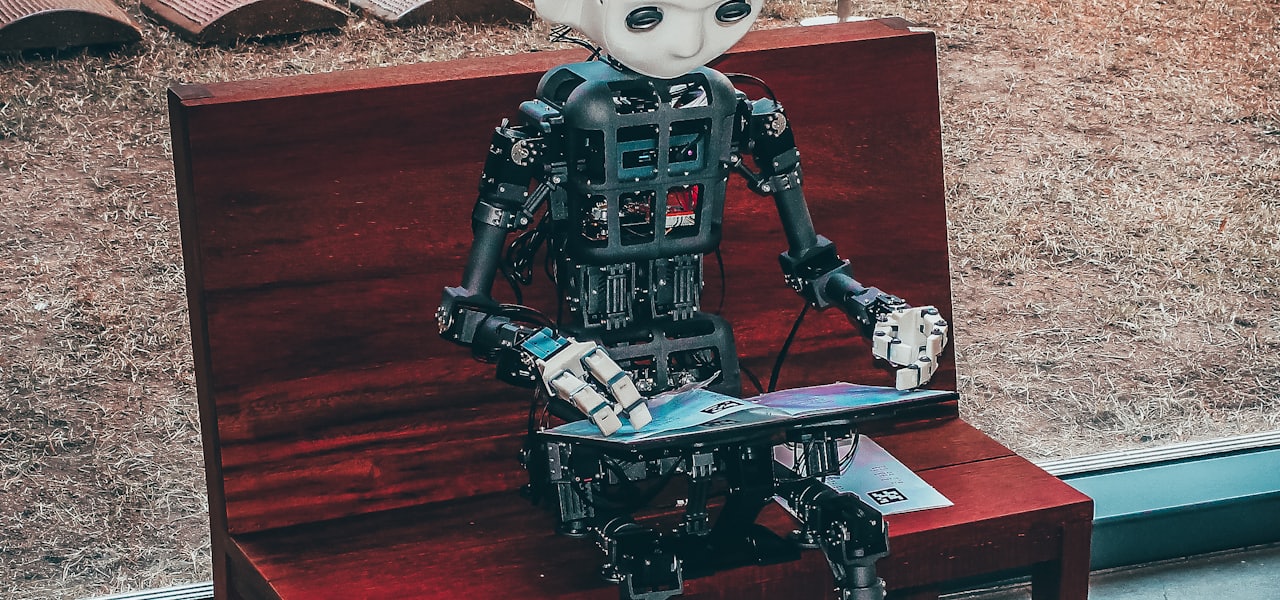
  • The Stories of Ibis

    The Stories of Ibis

    The Stories of Ibis (アイの物語, Ai no Monogatari) is a Japanese science-fiction light novel by Hiroshi Yamamoto (山本 弘) and translated by Takami Nieda. Yamamoto considered this to be an easier read than his earlier science fiction novel 'God Never Keeps Silent' because of its "light novel touch". The light novel was published in Japanese by Kadokawa Shoten and in English by Viz Media under their 'Haikasoru' imprint. The Stories of Ibis is told through a collection of short stories. All but two had been previously published. The two that Yamamoto wrote for the novel were 'The Day Shion Came' and 'AI's Story'. This is similar to The Illustrated Man by Ray Bradbury. Yamamoto drew from Bradbury's idea of short stories that were loosely connected. He represented this influence in the novel by giving Ibis a facial tattoo. == Plot == The Stories of Ibis begins with a wandering storyteller who encounters Ibis. He has the mindset that all robots are a threat to humanity and must be fought against for survival. He attacks the robot Ibis, not aware of who she is, as a result of his mindset. Ibis tells the storyteller that she is far more proficient in battle. During the battle the storyteller becomes injured and Ibis takes him to an android hospital to care for him. While he is recovering Ibis offers to tell him stories. While originally skeptical he agrees after Ibis makes it clear that the stories are not taboo. The space after each story is referred to as intermission and is a time for Ibis to comment on the story she just told. === The Universe on my Hands === The story is about a group of friends who are writing a science fiction story over the internet. One of the group members kills someone in real life. The rest of the short story is about how the group fights to convince this man to not commit suicide, but to turn himself in. He resolves to turn himself in, being hopeful to the future because he knows he has friends who care about him. The ending words of the story are a commentary. While the story they were writing was not real, the emotions they were feeling were real. === A Romance in Virtual Space === This is another story about human interactions over the internet. The device that allows people to enter virtual reality (VR) is MUGEN Net. Such devices are extremely expensive and most people need to go to a public server to use one. However the girl's parents in this story are wealthy enough to own one. This girl is shopping in VR when a boy meets her and asks her out for ice cream. All goes well and they plan for another. After some time of VR dating and awesome adventures with a female heroine, they agree to meet up in real life. He discovers that in reality, she is blind, yet he thinks she is brave and they continue dating. It's a wonderful short story of a secret utopia inside a dystopian culture of technology. === Mirror Girl === A short story about an artificial intelligence that grows over time with human interaction. The inspiration for this story was Ray Bradbury's I Sing the Body Electric. The mirror girl Shalice starts off with basic knowledge and by interacting with her owner develops. The owner grows up and marries a technician who incubates Shalice by teaching her in the virtual world at many thousand times faster than average life. When he is done, Strong Eye is created. Strong Eye is the fully developed and completely intelligent AI. === Black Hole Diver === A futuristic story about an artificial space station and people who go diving into a black hole. The space station cannot stop people but is sorry that they go to their deaths because none of them get past the event horizon. Then one girl comes who has the space ship, the training, and the research necessary to attempt to dive into the black hole. As she goes into the black hole the space station can no longer observe. She may have made it, she could have been destroyed. === A World Where Justice is Just === An anime flavored story about the intelligence of people being scanned onto a computer network. The AIs in the network fight crime and live repeating lives. At the end of each year they start anew, but different story lines. Thousands of 'extras' populate the network and are the ones subject to harm and deletion. The protagonist has a pen pal in real life who explains to her that the real world is under attack and that there are no respawns and no extras. The AI finds this so cruel that people would willingly kill each other when they can't come back. === The Day Shion Came === The stories leading up to this were all relatively short. This and the next took up over 100 pages each. This is a story about an android named Shion who works in a Japanese nursing facility. Shion comes with only extensive nursing training but lacks the knowledge of how to communicate with the residents. After months of training she informs her adviser that she believes all humans have dementia, which explains their irrational behavior. Near the end of the story one of the residents threatens suicide but Shion convinces him to step down and be rational. === AI's Story === The culminating story of the entire novel. It is about Ibis herself. She starts off as a virtual reality fighting program and over time develops intelligence. Her master gains enough funds to create her a body in the real world or level 0. There is significant hate against TAIs (True Artificial Intelligence) in the real world. Ibis and her friend Raven rebel against their masters to make a point. Human hatred was destroying them. After many years robots took prevalence and most humans realized they were not worthy to be the guardians of Earth and died in peace. The remaining population was stubborn and fought against the robots for centuries. The storyteller is a child of this generation, being raised in hatred and ignorance. The robots sought to take him captive, and teach him the truth so that he could go to the villages where people lived and teach them the truth. The whole point was they cared for the humans and wanted them to live in peace, rather than fighting for their survival. == Reception == It was reviewed by the Denver Post to be an "excellent novel". Being a Japanese novel translated to English, it has a small audience. The novel was given a 3.85 of 5 by the reviewers at Librarything.com. The reviewers of Google Books gave it a 4.33 of 5.

    Read more →
  • Curse of dimensionality

    Curse of dimensionality

    The curse of dimensionality refers to various phenomena that arise when analyzing and organizing data in high-dimensional spaces that do not occur in low-dimensional settings such as the three-dimensional physical space of everyday experience. The expression was coined by Richard E. Bellman when considering problems in dynamic programming. The curse generally refers to issues that arise when the number of datapoints is small (in a suitably defined sense) relative to the intrinsic dimension of the data. Dimensionally cursed phenomena occur in domains such as numerical analysis, sampling, combinatorics, machine learning, data mining and databases. The common theme of these problems is that when the dimensionality increases, the volume of the space increases so fast that the available data becomes sparse. In order to obtain a reliable result, the amount of data needed often grows exponentially with the dimensionality. Also, organizing and searching data often relies on detecting areas where objects form groups with similar properties; in high dimensional data, however, all objects appear to be sparse and dissimilar in many ways, which prevents common data organization strategies from being efficient. == Domains == === Combinatorics === In some problems, each variable can take one of several discrete values, or the range of possible values is divided to give a finite number of possibilities. Taking the variables together, a huge number of combinations of values must be considered. This effect is also known as the combinatorial explosion. Even in the simplest case of d {\displaystyle d} binary variables, the number of possible combinations already is 2 d {\displaystyle 2^{d}} , exponential in the dimensionality. Naively, each additional dimension doubles the effort needed to try all combinations. === Sampling === There is an exponential increase in volume associated with adding extra dimensions to a mathematical space. For example, 102 = 100 evenly spaced sample points suffice to sample a unit interval (try to visualize a "1-dimensional" cube, i.e. a line) with no more than 10−2 = 0.01 distance between points; an equivalent sampling of a 10-dimensional unit hypercube with a lattice that has a spacing of 10−2 = 0.01 between adjacent points would require 1020 = [(102)10] sample points. In general, with a spacing distance of 10−n the 10-dimensional hypercube appears to be a factor of 10n(10−1) = [(10n)10/(10n)] "larger" than the 1-dimensional hypercube, which is the unit interval. In the above example n = 2: when using a sampling distance of 0.01 the 10-dimensional hypercube appears to be 1018 "larger" than the unit interval. This effect is a combination of the combinatorics problems above and the distance function problems explained below. === Optimization === When solving dynamic optimization problems by numerical backward induction, the objective function must be computed for each combination of values. This is a significant obstacle when the dimension of the "state variable" is large. === Machine learning === In machine learning problems that involve learning a "state-of-nature" from a finite number of data samples in a high-dimensional feature space with each feature having a range of possible values, typically an enormous amount of training data is required to ensure that there are several samples with each combination of values. In an abstract sense, as the number of features or dimensions grows, the amount of data we need to generalize accurately grows exponentially. A typical rule of thumb is that there should be at least 5 training examples for each dimension in the representation. In machine learning and insofar as predictive performance is concerned, the curse of dimensionality is used interchangeably with the peaking phenomenon, which is also known as Hughes phenomenon. This phenomenon states that with a fixed number of training samples, the average (expected) predictive power of a classifier or regressor first increases as the number of dimensions or features used is increased but beyond a certain dimensionality it starts deteriorating instead of improving steadily. Nevertheless, in the context of a simple classifier (e.g., linear discriminant analysis in the multivariate Gaussian model under the assumption of a common known covariance matrix), Zollanvari et al. showed both analytically and empirically that as long as the relative cumulative efficacy of an additional feature set (with respect to features that are already part of the classifier) is greater (or less) than the size of this additional feature set, the expected error of the classifier constructed using these additional features will be less (or greater) than the expected error of the classifier constructed without them. In other words, both the size of additional features and their (relative) cumulative discriminatory effect are important in observing a decrease or increase in the average predictive power. In metric learning, higher dimensions can sometimes allow a model to achieve better performance. After normalizing embeddings to the surface of a hypersphere, FaceNet achieves the best performance using 128 dimensions as opposed to 64, 256, or 512 dimensions in one ablation study. A loss function for unitary-invariant dissimilarity between word embeddings was found to be minimized in high dimensions. === Data mining === In data mining, the curse of dimensionality refers to a data set with too many features. Consider the first table, which depicts 200 individuals and 2000 genes (features) with a 1 or 0 denoting whether or not they have a genetic mutation in that gene. A data mining application to this data set may be finding the correlation between specific genetic mutations and creating a classification algorithm such as a decision tree to determine whether an individual has cancer or not. A common practice of data mining in this domain would be to create association rules between genetic mutations that lead to the development of cancers. To do this, one would have to loop through each genetic mutation of each individual and find other genetic mutations that occur over a desired threshold and create pairs. They would start with pairs of two, then three, then four until they result in an empty set of pairs. The complexity of this algorithm can lead to calculating all permutations of gene pairs for each individual or row. Given the formula for calculating the permutations of n items with a group size of r is: n ! ( n − r ) ! {\displaystyle {\frac {n!}{(n-r)!}}} , calculating the number of three pair permutations of any given individual would be 7988004000 different pairs of genes to evaluate for each individual. The number of pairs created will grow by an order of factorial as the size of the pairs increase. The growth is depicted in the permutation table (see right). As we can see from the permutation table above, one of the major problems data miners face regarding the curse of dimensionality is that the space of possible parameter values grows exponentially or factorially as the number of features in the data set grows. This problem critically affects both computational time and space when searching for associations or optimal features to consider. Another problem data miners may face when dealing with too many features is that the number of false predictions or classifications tends to increase as the number of features grows in the data set. In terms of the classification problem discussed above, keeping every data point could lead to a higher number of false positives and false negatives in the model. This may seem counterintuitive, but consider the genetic mutation table from above, depicting all genetic mutations for each individual. Each genetic mutation, whether they correlate with cancer or not, will have some input or weight in the model that guides the decision-making process of the algorithm. There may be mutations that are outliers or ones that dominate the overall distribution of genetic mutations when in fact they do not correlate with cancer. These features may be working against one's model, making it more difficult to obtain optimal results. This problem is up to the data miner to solve, and there is no universal solution. The first step any data miner should take is to explore the data, in an attempt to gain an understanding of how it can be used to solve the problem. One must first understand what the data means, and what they are trying to discover before they can decide if anything must be removed from the data set. Then they can create or use a feature selection or dimensionality reduction algorithm to remove samples or features from the data set if they deem it necessary. One example of such methods is the interquartile range method, used to remove outliers in a data set by calculating the standard deviation of a feature or occurrence. === Distance function === When a measure such as a Euclidean distance is defined using many coordinat

    Read more →
  • Anytime algorithm

    Anytime algorithm

    In computer science, an anytime algorithm is an algorithm that can return a valid solution to a problem even if it is interrupted before it ends. The algorithm is expected to find better and better solutions the longer it keeps running. Most algorithms run to completion: they provide a single answer after performing some fixed amount of computation. In some cases, however, the user may wish to terminate the algorithm prior to completion. The amount of computation required may be substantial, for example, and computational resources might need to be reallocated. Most algorithms either run to completion or they provide no useful solution information. Anytime algorithms, however, are able to return a partial answer, whose quality depends on the amount of computation they were able to perform. The answer generated by anytime algorithms is an approximation of the correct answer. == Names == An anytime algorithm may be also called an "interruptible algorithm". They are different from contract algorithms, which must declare a time in advance; in an anytime algorithm, a process can just announce that it is terminating. == Goals == The goal of anytime algorithms are to give intelligent systems the ability to make results of better quality in return for turn-around time. They are also supposed to be flexible in time and resources. They are important because artificial intelligence or AI algorithms can take a long time to complete results. This algorithm is designed to complete in a shorter amount of time. Also, these are intended to have a better understanding that the system is dependent and restricted to its agents and how they work cooperatively. An example is the Newton–Raphson iteration applied to finding the square root of a number. Another example that uses anytime algorithms is trajectory problems when you're aiming for a target; the object is moving through space while waiting for the algorithm to finish and even an approximate answer can significantly improve its accuracy if given early. What makes anytime algorithms unique is their ability to return many possible outcomes for any given input. An anytime algorithm uses many well defined quality measures to monitor progress in problem solving and distributed computing resources. It keeps searching for the best possible answer with the amount of time that it is given. It may not run until completion and may improve the answer if it is allowed to run longer. This is often used for large decision set problems. This would generally not provide useful information unless it is allowed to finish. While this may sound similar to dynamic programming, the difference is that it is fine-tuned through random adjustments, rather than sequential. Anytime algorithms are designed so that it can be told to stop at any time and would return the best result it has found so far. This is why it is called an interruptible algorithm. Certain anytime algorithms also maintain the last result, so that if they are given more time, they can continue from where they left off to obtain an even better result. == Decision trees == When the decider has to act, there must be some ambiguity. Also, there must be some idea about how to solve this ambiguity. This idea must be translatable to a state to action diagram. == Performance profile == The performance profile estimates the quality of the results based on the input and the amount of time that is allotted to the algorithm. The better the estimate, the sooner the result would be found. Some systems have a larger database that gives the probability that the output is the expected output. One algorithm can have several performance profiles. Most of the time performance profiles are constructed using mathematical statistics using representative cases. For example, in the traveling salesman problem, the performance profile was generated using a user-defined special program to generate the necessary statistics. In this example, the performance profile is the mapping of time to the expected results. This quality can be measured in several ways: certainty: where probability of correctness determines quality accuracy: where error bound determines quality specificity: where the amount of particulars determine quality == Algorithm prerequisites == Initial behavior: While some algorithms start with immediate guesses, others take a more calculated approach and have a start up period before making any guesses. Growth direction: How the quality of the program's "output" or result, varies as a function of the amount of time ("run time") Growth rate: Amount of increase with each step. Does it change constantly, such as in a bubble sort or does it change unpredictably? End condition: The amount of runtime needed

    Read more →
  • Fuzzy markup language

    Fuzzy markup language

    Fuzzy Markup Language (FML) is a specific purpose markup language based on XML, used for describing the structure and behavior of a fuzzy system independently of the hardware architecture devoted to host and run it. == Overview == FML was designed and developed by Giovanni Acampora during his Ph.D. course in Computer Science, at University of Salerno, Italy, in 2004. The original idea inspired Giovanni Acampora to create FML was the necessity of creating a cooperative fuzzy-based framework aimed at automatically controlling a living environment characterized by a plethora of heterogeneous devices whose interactions were devoted to maximize the human comfort under energy saving constraints. This framework represented one of the first concrete examples of Ambient Intelligence. Beyond this pioneering application, the major advantage of using XML to describe a fuzzy system is hardware/software interoperability. Indeed, all that is needed to read an FML file is the appropriate schema for that file, and an FML parser. This markup approach makes it much easier to exchange fuzzy systems between software: for example, a machine learning application could extract fuzzy rules which could then be read directly into a fuzzy inference engine or uploaded into a fuzzy controller. Also, with technologies like XSLT, it is possible to compile the FML into the programming language of your choice, ready for embedding into whatever application you please. As stated by Mike Watts on his popular Computational Intelligence blog: "Although Acampora's motivation for developing FML seems to be to develop embedded fuzzy controllers for ambient intelligence applications, FML could be a real boon for developers of fuzzy rule extraction algorithms: from my own experience during my PhD, I know that having to design a file format and implement the appropriate parsers for rule extraction and fuzzy inference engines can be a real pain, taking as much time as implementing the rule extraction algorithm itself. I would much rather have used something like FML for my work." A complete overview of FML and related applications can be found in the book titled On the power of Fuzzy Markup Language edited by Giovanni Acampora, Chang-Shing Lee, Vincenzo Loia and Mei-Hui Wang, and published by Springer in the series Studies on Fuzziness and Soft Computing. == Syntax, grammar and hardware synthesis == FML allows fuzzy systems to be coded through a collection of correlated semantic tags capable of modeling the different components of a classical fuzzy controller such as knowledge base, rule base, fuzzy variables and fuzzy rules. Therefore, the FML tags used to build a fuzzy controller represent the set of lexemes used to create fuzzy expressions. In order to design a well-formed XML-based language, an FML context-free grammar is defined by means of a XML schema which defines name, type and attributes characterized each XML element. However, since an FML program represents only a static view of a fuzzy logic controller, XSLT is provided to change this static view to a computable version. Indeed, XSLTs modules are able to convert the FML-based fuzzy controller in a general purpose computer language using an XSL file containing the translation description. At this level, the control is executable for the hardware. In short, FML is essentially composed by three layers: XML in order to create a new markup language for fuzzy logic control; a XML Schema in order to define the legal building blocks; eXtensible Stylesheet Language Transformations (XSLT) in order to convert a fuzzy controller description into a specific programming language. === Syntax === FML syntax is composed of XML tags and attributes which describe the different components of a fuzzy logic controller listed below: fuzzy knowledge base; fuzzy rule base; inference engine fuzzification subsystem; defuzzification subsystem. In detail, the opening tag of each FML program is which represents the fuzzy controller under modeling. This tag has two attributes: name and ip. The first attribute permits to specify the name of fuzzy controller and ip is used to define the location of controller in a computer network. The fuzzy knowledge base is defined by means of the tag which maintains the set of fuzzy concepts used to model the fuzzy rule base. In order to define the fuzzy concept related controlled system, tag uses a set of nested tags: defines the fuzzy concept; defines a linguistic term describing the fuzzy concept; a set of tags defining a shape of fuzzy sets are related to fuzzy terms. The attributes of tag are: name, scale, domainLeft, domainRight, type and, for only an output, accumulation, defuzzifier and defaultValue. The name attribute defines the name of fuzzy concept, for instance, temperature; scale is used to define the scale used to measure the fuzzy concept, for instance, Celsius degree; domainLeft and domainRight are used to model the universe of discourse of fuzzy concept, that is, the set of real values related to fuzzy concept, for instance [0°,40°] in the case of Celsius degree; the position of fuzzy concept into rule (consequent part or antecedent part) is defined by type attribute (input/output); accumulation attribute defines the method of accumulation that is a method that permits the combination of results of a variable of each rule in a final result; defuzzifier attribute defines the method used to execute the conversion from a fuzzy set, obtained after aggregation process, into a numerical value to give it in output to system; defaultValue attribute defines a real value used only when no rule has fired for the variable at issue. As for tag , it uses two attributes: name used to identify the linguistic value associate with fuzzy concept and complement, a boolean attribute that defines, if it is true, it is necessary to consider the complement of membership function defined by given parameters. Fuzzy shape tags, used to complete the definition of fuzzy concept, are: Every shaping tag uses a set of attributes which defines the real outline of corresponding fuzzy set. The number of these attributes depends on the chosen fuzzy set shape. In order to make an example, consider the Tipper Inference System described in Mathworks Matlab Fuzzy Logic Toolbox Tutorial. This Mamdani system is used to regulate the tipping in, for example, a restaurant. It has got two variables in input (food and service) and one in output (tip). FML code for modeling part of knowledge base of this fuzzy system containing variables food and tip is shown below. A special tag that can furthermore be used to define a fuzzy shape is . This tag is used to customize fuzzy shape (custom shape). The custom shape modeling is performed via a set of tags that lists the extreme points of geometric area defining the custom fuzzy shape. Obviously, the attributes used in tag are x and y coordinates. As for rule base component, FML allows to define a set of rule bases, each one of them describes a different behavior of system. The root of each rule base is modeled by tag which defines a fuzzy rule set. The tag uses five attributes: name, type, activationMethod, andMethod and orMethod. Obviously, the name attribute uniquely identifies the rule base. The type attribute permits to specify the kind of fuzzy controller (Mamdani or TSK) respect to the rule base at issue. The activationMethod attribute defines the method used to implication process; the andMethod and orMethod attribute define, respectively, the and and or algorithm to use by default. In order to define the single rule the tag is used. The attributes used by the tag are: name, connector, operator and weight. The name attribute permits to identify the rule; connector is used to define the logical operator used to connect the different clauses in antecedent part (and/or); operator defines the algorithm to use for chosen connector; weight defines the importance of rule during inference engine step. The definition of antecedent and consequent rule part is obtained by using and tags. tag is used to model the fuzzy clauses in antecedent and consequent part. This tag use the attribute modifier to describe a modification to term used in the clause. The possible values for this attribute are: above, below, extremely, intensify, more or less, norm, not, plus, slightly, somewhat, very, none. To complete the definition of fuzzy clause the nested and tags have to be used. A sequence of tags realizes a fuzzy rule base. As example, consider a Mamdani rule composed by (food is rancid) OR (servi

    Read more →